
Deep Plane Facelift in Beverly Hills, CA | Dr. Daniel Golshani
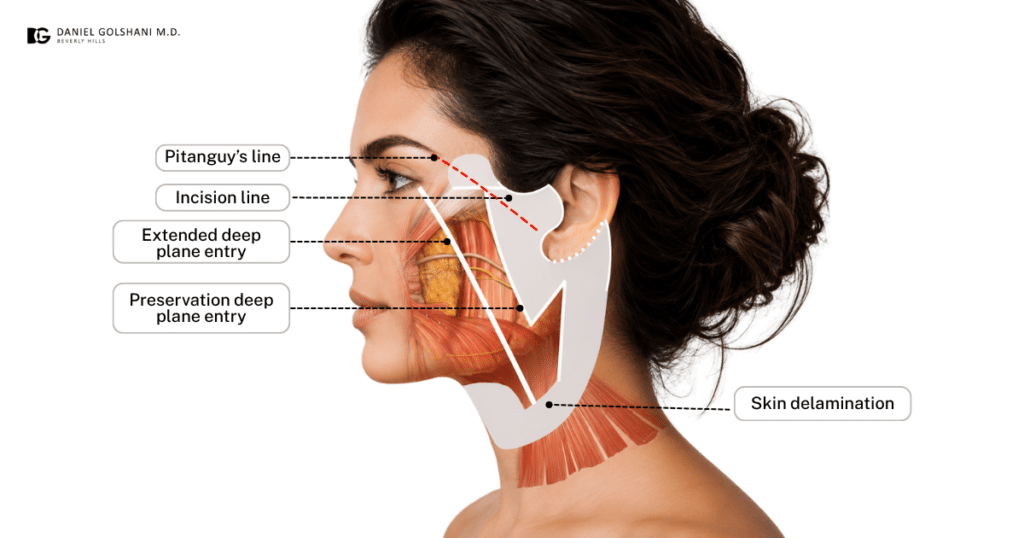
The deep plane facelift is the most advanced and comprehensive surgical approach to facial rejuvenation available today — and for patients in Beverly Hills seeking results that are truly invisible to the outside world, it remains the gold standard. Unlike older techniques that pulled only at the skin, the deep plane method works beneath the surface, repositioning the SMAS — the superficial musculoaponeurotic system — the deep muscle and fibrous layer that gravity and time have displaced downward. The result is not a tighter face. It is a younger face: lifted cheeks, a sharper jawline, a cleaner neck, and a restored midface — all without the telltale signs of surgery.
Dr. Daniel Golshani, double-board-certified plastic surgeon at his Wilshire Boulevard practice in Beverly Hills, has devoted his surgical career to the art of the face. His deep plane facelift patients don’t look like they’ve had work done. They look like themselves — only ten to fifteen years younger.


What Is a Deep Plane Facelift?
A facelift, or rhytidectomy, is surgery to reverse common signs of aging. Early facelifts did this by tightening only the facial skin, sometimes creating an unnaturally stretched or “windswept look.” A modern deep plane or SMAS (superficial musculoaponeurotic system) facelift works with all the layers of facial tissue, addressing the underlying structural changes of facial aging. By raising and reattaching muscle tissue, a younger foundation is restored. Building on this, fat that has shifted downward is repositioned—to the cheeks or under the eyes, for example. Only as a final step is facial skin smoothed to erase wrinkles and lines, and excess tissue is removed. The result is a subtle and long-lasting transformation that brings out the unique beauty of each patient’s face without distorting their features.
Meet Beverly Hills Plastic Surgeon
Daniel Golshani, MD, FACS
Dr. Golshani is a double board-certified plastic surgeon who is committed to enhancing your natural beauty. With a focus on balance, harmony, and symmetry, he is passionate about making aesthetic goals a reality at his Beverly Hills practice. We are not only dedicated to your personal cosmetic beauty, but also to ensuring your health, safety, and comfort.

Why Beverly Hills Patients Choose Dr. Golshani for Deep Plane Facelift Surgery
Beverly Hills sits at the center of the world’s most sophisticated aesthetic market. The patients who walk into Dr. Golshani’s Wilshire Boulevard practice have seen the results of surgery that falls short — the tight faces, the distorted features, the results that announce themselves in every room. They are not looking for a change. They are looking for a restoration.
Dr. Daniel Golshani, MD, FACS is a double-board-certified plastic and reconstructive surgeon with advanced fellowship training in cosmetic surgery and a subspecialty focus on complex facial procedures. He trained under some of the most respected names in American plastic surgery and has spent his career refining the deep plane technique to produce results that are both structurally durable and visually invisible as surgery.
His practice at 9301 Wilshire Blvd., Suite 410 in Beverly Hills serves patients from Beverly Hills, Bel Air, Brentwood, West Hollywood, Pacific Palisades, Santa Monica, and internationally — patients who specifically seek out a surgeon with the anatomical precision and aesthetic judgment that the deep plane facelift demands.
The Deep Plane Face Lift: History, Evolution, and Current Techniques
Where It All Began: The Skin-Only Facelift Era
The history of the facelift begins, modestly, with skin. The earliest facelifts — performed in the early twentieth century — did nothing more than excise small ellipses of facial skin near the hairline and ears, pulling it taut and hoping the tension would hold. For a time, it did. But the results were fleeting, and the telltale signs were unmistakable: the swept-back temples, the distorted hairline, the unnaturally tight cheeks. The skin-only facelift could buy a few years, but it could not buy youth.
Surgeons of that era understood the limitation. Skin alone has no structural memory. It stretches. It relaxes. It reveals, eventually, that nothing underneath it was ever corrected.
Tord Skoog and the Discovery of a Deeper Layer
The first significant leap forward came from Swedish plastic surgeon Tord Skoog, who in 1972 described a technique that went beneath the skin for the first time.
Skoog recognized that the face had a distinct fibromuscular layer sitting between the skin and the deeper facial muscles — a layer that, when properly released and repositioned, could hold a lift far longer and more naturally than any skin-tightening maneuver ever could.
His work was the conceptual seed for everything that followed.
Mitz and Peyronie: Naming the Architecture
Two years later, in 1974, French surgeons Vladimir Mitz and Martine Peyronie published the landmark anatomical description that gave this layer its name: the SMAS — the superficial musculoaponeurotic system. Their paper was a turning point. By naming and mapping the SMAS, Mitz and Peyronie handed the surgical community the anatomical framework it needed to evolve. The SMAS facelift was born: surgeons could now address the structural layer of the face, plicate or imbricate it, and achieve results that skin excision alone never could.
Dr. Golshani had the privilege of meeting Vladimir Mitz in person in Paris, France, an encounter with the surgeon who named the very layer that defines modern facelift surgery. That conversation left a lasting impression, and its influence is reflected in the precision and philosophy Dr. Golshani brings to every facelift he performs today.
The SMAS facelift became the standard of care through the 1980s and represented a genuine generation of improvement over the skin-only technique.
John Q. Owsley and the Composite Approach
But even SMAS-level work had its ceiling. The ligamentous attachments that anchor facial tissue to bone — the retaining ligaments — were left untouched in traditional SMAS procedures. This meant that while the SMAS could be tightened, the deeper facial compartments — particularly the midface and the malar fat pad — remained descended and unchanged.
San Francisco-based surgeon John Q. Owsley was among the early pioneers who pushed below the SMAS, working to release these ligaments and reposition the deeper soft tissue as a composite unit together with the skin above it. His contributions moved the field toward the midface and laid critical groundwork for the next evolution.
Dr. Golshani had the privilege of training directly under Dr. Owsley during his fellowship, an experience that shaped his foundational understanding of composite tissue lifting and cemented his commitment to operating at the deeper anatomical planes where lasting results are actually made.
Sam Hamra and the True Deep Plane
It was Sam Hamra, in his landmark 1992 paper, who crystallized the technique into what we now recognize as the true deep plane facelift. Hamra described a surgical approach that released the face at the level of the retaining ligaments — the zygomatic and masseteric — and elevated the entire soft tissue of the cheek, the nasolabial fold, and the jowl as one unified composite flap.
The implications were profound. By releasing the tissues that had been anchoring the face to the skeleton in a descended position, surgeons could now reposition rather than simply retighten. The nasolabial fold — the deep crease that descends from the nose to the corners of the mouth and had long been considered the Achilles heel of facelift surgery — could now be corrected directly, by lifting the malar fat pad back to its youthful position, not by pulling skin laterally and hoping for the best.
Hamra’s deep plane facelift produced results that, for the first time, could genuinely be described as natural. And those results lasted.
The Modern Deep Plane: What It Actually Does
Understanding the history makes the technique easier to appreciate. Today’s deep plane facelift, as performed by Dr. Golshani in Beverly Hills, works systematically across every structural layer and every zone of the aging face:
The Neck Aging of the neck manifests as platysmal banding — the vertical cords that appear as the platysma muscle separates and loses tone — along with submental fat accumulation, skin laxity, and the loss of the crisp cervicomental angle that defines a youthful jawline-to-neck transition. The deep plane approach addresses the neck comprehensively: the platysma is tightened, excess fat is addressed, and the skin of the neck is re-draped in harmony with the work done above.
The Face and Jawline The jowls that define a prematurely aged lower face are the product of descended SMAS and malar fat, combined with a loss of bony jawline definition. The deep plane releases these tissues at their ligamentous anchors and repositions them superiorly and posteriorly — recreating the strong, sharp jawline architecture of a younger face without ever pulling the skin tightly.
The Midface The midface is the most technically demanding zone of facial rejuvenation. The flattened cheeks, the hollows beneath the eyes, and the deepened nasolabial folds are all manifestations of the malar fat pad descending from its youthful, high-cheek position. The deep plane facelift uniquely addresses this by lifting the malar fat pad as part of the composite flap, restoring fullness to the cheeks and softening the nasolabial crease through structural repositioning — not filler, not tension.
The Upper Face and Brow While the deep plane facelift proper is concentrated in the mid and lower face, a complete facial rejuvenation frequently incorporates the upper face and brow. A descended brow contributes to orbital heaviness and a tired, sometimes angry appearance. An endoscopic brow lift or forehead lift, when combined with a deep plane facelift, completes the picture — lifting the lateral brow to its anatomically youthful position and opening the upper third of the face.
Adjunctive Procedures: The Architecture of a Harmonious Result
The deep plane facelift is not performed in isolation. It is the foundation of a comprehensive facial rejuvenation — but the most skillful surgeons understand that a face ages as a whole, and that correcting one zone while leaving others untouched can produce results that feel incomplete or incongruent.
Dr. Golshani routinely combines the deep plane facelift with a tailored selection of adjunctive procedures, chosen specifically for each patient’s anatomy and aesthetic goals:
- Neck Lift — to address platysmal banding, submental fullness, and skin laxity below the jawline
- Blepharoplasty (Eyelid Surgery) — upper and/or lower, to address hooded lids, under-eye bags, and the skin laxity that ages the periorbital frame
- Endoscopic Brow Lift — to restore the lateral brow arc and open the upper face
- Fat Grafting with G-Stem™ — to restore volume to the midface, temples, and periorbital areas where deflation has occurred with age
- Laser Resurfacing — to improve skin quality, texture, and tone, addressing the surface-level aging that no lift alone can correct
- Facial Implants — in select cases, to enhance the underlying skeletal framework of the chin or jaw
The goal is always a result that looks harmonious — where no single zone appears disproportionately refreshed while the rest of the face lags behind. Dr. Golshani’s philosophy is that the ideal deep plane facelift patient should leave his Beverly Hills practice looking like a well-rested, younger version of themselves. Not altered. Not operated upon. Simply — better.
The Invisible Signs of Surgery: Dr. Golshani’s Standard
The most reliable indicator of a technically excellent deep plane facelift is what is absent in the result. There is no lateral pull distorting the oral commissure. There is no widened scar. The hairline has not shifted. The earlobe has not elongated or been displaced. The nasolabial fold has softened through structural lift, not skin tension. The face moves naturally when the patient speaks, smiles, and laughs.
These are not accidents. They are the product of surgical planning, anatomical precision, and a philosophy that places the patient’s natural appearance above any other consideration. Dr. Golshani has built his practice — and his reputation among Beverly Hills and international patients — on this standard.
Facelift Approaches and Options
Depending on your needs, Dr. Golshani will recommend one of several surgical approaches. The choice depends on the degree of laxity in your facial skin, the extent of downward muscle and fat migration, and which parts of the face need correction.
Deep Plane Facelift
A Fusion Facelift Beverly Hills approach utilizes the advanced deep plane or SMAS facelift describes the modern technique of lifting and reattaching facial muscles, transferring fat to create youthful contours, and subtly tightening and smoothing skin that has stretched, wrinkled, and sagged. In this approach, well-concealed incisions are made along the hairline and around the ears. Through these incisions, Dr. Golshani accesses the muscles and fat below the skin and gently tightens the lax skin. A deep plane facelift rejuvenates the face from below the eyes, through the cheeks, to the jawline.
Mid-Facelift or Cheek Lift
When the signs of facial aging are limited to the area from the corners of the eyes to the corners of the mouth, a mid-facelift or cheek lift may be the best approach. Incisions are made in the hairline and inside the mouth to smooth lines and creases around the eyes and mouth and improve the appearance of the cheeks, nose, and mouth.
Lower Facelift
When the signs of aging are concentrated in the lower part of the face, from the corners of the mouth to the jawline, a lower facelift may be the solution. The incisions for a lower facelift are usually around the ears and along the hairline to the temple. A lower facelift can eliminate jowls to give the jawline more definition and smooth nasolabial folds or smile lines, the creases that extend from the sides of the nose around the corners of the mouth
Mini Facelift
A mini facelift can be a good choice for younger patients who have moderate signs of facial aging but don’t have a problem with skin laxity. Two short incisions are made around the ears, through which muscles and fat can be repositioned. The small incisions don’t allow for the removal of excess skin, so the approach isn’t appropriate when skin tightening is required.
Hybrid Facelift
Different deep plane facelift techniques can be combined to address the unique concerns of patients. A hybrid facelift is the term for these combined approaches. In a hybrid facelift, Dr. Golshani uses shorter incisions than he would for a typical deep plane facelift, and makes changes precisely calibrated to lift, sculpt, trim, and add volume where necessary to rejuvenate and bring out the best in the patient’s facial appearance.
Combining a Face Lift with Other Procedures
A facelift reverses signs of aging in the middle and lower parts of your face—from below your eyes to your jawline and under your chin. By itself, a facelift is a wonderfully transformative procedure, but it doesn’t address loose skin, dropping, or lines and creases in your neck, eyelids, brows, or forehead. For a more comprehensive facial rejuvenation, many of our Beverly Hills patients combine a facelift with a neck lift, brow lift, or eyelid surgery. Dr. Golshani is a true expert at customizing a series of procedures to help you look naturally younger and refreshed.
A facelift can also be combined with non-surgical treatments, such as laser treatments and chemical peels, to improve skin quality and eliminate areas of discoloration, such as sun or age spots, freckles, or acne scars. Other non-surgical options include Botox® to address wrinkles, dermal fillers to enhance contours, and chemical peels to resurface the skin.
“Making the choice to have facelift surgery was easily one of the best decisions I’ve made, thanks to Dr. Golshani.”
Your Deep Plane Facelift Journey: Step-by-Step
Step 1 — The Consultation
Your consultation with Dr. Golshani begins with a detailed conversation about your goals, your medical history, and your timeline. Dr. Golshani will examine the quality of your facial skin, the position of your SMAS and malar fat pad, the condition of your neck and platysma, and the overall architecture of your face. He does not offer a menu of procedures — he develops a surgical plan specific to your anatomy. A patient coordinator attends every consultation, taking detailed notes on what is discussed and decided, so that nothing is lost between your visit and your surgery date.
Step 2 — Preparation
In the weeks before surgery, Dr. Golshani will guide you through specific preparation steps: discontinuing medications that increase bleeding risk, stopping smoking (mandatory for at least six weeks before and after surgery), optimizing your nutrition and skin health, and arranging your post-operative recovery environment. His team will ensure you have everything you need before your surgery day arrives.
Step 3 — The Procedure
The deep plane facelift is performed under general anesthesia at the Rexford Surgical Institute — a state-of-the-art, accredited surgical center located on the same floor as Dr. Golshani’s office. Incisions are placed with precision along the natural hairline and in the contours surrounding the ear, where they will be entirely hidden once healed. Through these incisions, Dr. Golshani releases the retaining ligaments, repositions the composite SMAS-skin flap superiorly and posteriorly, addresses the neck and platysma as indicated, and re-drapes the skin without tension. The procedure typically takes two to four hours, depending on the scope of combined procedures.
Step 4 — Recovery
You will go home the same day, accompanied by a trusted adult. Plan to rest for the first week. Swelling and bruising are expected and normal — keeping your head elevated and applying cold compresses will help manage both. Most patients feel socially presentable within ten to fourteen days. Strenuous activity is restricted for six weeks. Final results — with all swelling fully resolved — are typically visible at the three-month mark, with continued refinement over six to twelve months.
Planning Your Los Angeles Facelift
A facelift is a highly customized procedure that must be carefully planned and expertly performed to enhance and not distort your natural appearance. Your consultation with Dr. Golshani is a critical step in planning your successful facelift. A patient coordinator will meet with you briefly before Dr. Golshani joins the consultation and will stay in the room to take notes on what is discussed and decided. Dr. Golshani will ask questions to understand your goals for treatment and gather your medical history. He will then examine you to assess the quality of your facial skin, the underlying bone and cartilage structure, and the extent to which facial fat has shifted downward. Based on what you tell Dr. Golshani about your goals and what he learns from the examination, he will recommend an approach to the surgery. He will explain what you can expect throughout the process, how to prepare for surgery and care for yourself afterward, your likely outcome, and your risks.
Dr. Golshani will answer any questions you may have about the surgery, and the patient coordinator will meet with you afterward to answer all of your non-surgical questions. It’s Dr. Golshani’s goal to ensure you have the necessary information to make an informed decision about your procedure and you understand your role in preparing yourself and caring for yourself afterward.
Are You a Good Candidate for a Facelift?
During your consultation, Dr. Golshani will inform you of whether you are a good candidate for a facelift, and if so, what approach he recommends.
You are probably a good candidate for a facelift if you:
- are bothered by the signs of aging in your face, from below your eyes down to your jawline — signs such as loose skin, wrinkles, creases, jowls, or a double chin
- are in good overall health
- do not smoke, or can quit smoking for six weeks before and after the surgery
The ideal candidate for any plastic surgery procedure, including a facelift, has realistic expectations for the outcome of the surgery and is aware of the risks.
How to Prepare for Facelift Surgery
Dr. Golshani will provide specific instructions on how to prepare for your surgery. These may include measures to take in the weeks before surgery, such as stopping smoking and fortifying your health, and short-term measures, such as discontinuing certain medications and avoiding herbal supplements in the days just before your procedure.
Dr. Golshani will also provide an overview of how you can prepare your home, have what you need on hand, and fill prescriptions.
What to Expect on the Day of Your Los Angeles Deep Plane Facelift Procedure
Deep plane facelift surgery is performed on an outpatient basis, using general anesthesia. As with all our surgeries, it is performed in our state-of-the-art surgical center, the Rexford Surgical Institute, which is in our building on the same floor as our office.
Depending on the approach used, incisions will be made around your ears, along your hairline, or both. Through these incisions, Dr. Golshani will reposition facial muscles and fat, smooth the skin of your face, and remove excess skin and fat. The procedure usually takes about two or three hours, depending on the extent of the procedure.
You’ll be released after the anesthesia has worn off and you are fully alert. You can go home with a trusted friend or family member to drive you.
What to Expect After Your Facelift Surgery
You should plan to rest at home for the first week after surgery. We recommend that you have someone you trust stay with you for the first two or three days to assist you. You can expect swelling and bruising in the first few days. Keeping your head elevated and applying ice helps minimize swelling and promotes healing. Any discomfort you experience can be managed with pain medication. Dr. Golshani will provide thorough instructions on how to care for yourself as you recover and when to return for follow-up visits.
You’ll be able to resume light activity in about a week. Most patients take 10 days to two weeks off from work, to allow swelling and bruising to subside. You may need more time off if your job involves physical exertion. After about six weeks, you can begin to resume more strenuous activities.
Your plastic surgery results will be visible once the initial swelling resolves, and they will gradually improve over the following weeks. You’ll look great after two or three months.
Schedule Your Facelift Surgery Consultation in Beverly Hills
Contact us today to schedule a private consultation with Dr. Golshani to learn how a deep plane facelift can help restore your youthful appearance.
Facelift Surgery FAQs -Beverly Hills, CA
What is a deep plane facelift in Beverly Hills?
A deep plane facelift is a surgical procedure that lifts and repositions the SMAS — the deep muscular and fibrous layer beneath the skin — rather than simply tightening the skin’s surface. In Beverly Hills, Dr. Daniel Golshani performs the deep plane facelift to correct jowling, restore the midface and malar fat pad, sharpen the jawline, and rejuvenate the neck, delivering results that are structurally durable and completely natural in appearance.
How is a deep plane facelift different from a SMAS facelift?
A SMAS facelift tightens the SMAS layer but typically does not release the retaining ligaments that anchor descended facial tissue to the bone. A deep plane facelift goes further: it releases these ligaments — particularly the zygomatic and masseteric — allowing the entire composite soft tissue unit to be repositioned rather than simply tightened. This produces a more comprehensive correction of the midface, nasolabial fold, jowl, and neck, and results that last significantly longer.
Who were the pioneers of the deep plane facelift technique?
The deep plane facelift’s evolution spans several decades and is built on the contributions of foundational surgeons: Tord Skoog, who first described operating beneath the skin in 1974; Vladimir Mitz and Martine Peyronie, who named and mapped the SMAS in 1974; John Q. Owsley, who advanced composite tissue lifting; and Sam Hamra, whose 1992 paper defined the true deep plane technique as it is practiced today.
How much does a deep plane facelift cost in Beverly Hills?
The cost of a deep plane facelift in Beverly Hills varies depending on the scope of the procedure, whether adjunctive procedures are included, anesthesia, and surgical facility fees. Dr. Golshani’s team provides detailed, personalized cost estimates during the consultation. As a reference point, deep plane facelift surgery by a double-board-certified surgeon in Beverly Hills typically reflects the level of expertise, customization, and surgical facility standard involved.
How long does a deep plane facelift last?
The results of a deep plane facelift are among the most durable in facial plastic surgery — typically lasting ten to fifteen years or longer, because the procedure corrects aging at its structural source rather than simply re-tensioning the skin. Patients continue to age naturally but maintain a sustained advantage over their un-operated baseline. Complementary non-surgical treatments and a diligent skincare regimen can extend results further.
Am I a good candidate for a deep plane facelift?
Ideal candidates are individuals bothered by structural aging of the mid and lower face — descended cheeks, prominent jowls, deepened nasolabial folds, jawline laxity, and neck changes — who are in good general health, non-smokers (or committed to cessation), and have realistic expectations for the outcome. Dr. Golshani evaluates each patient individually; age is not a disqualifying factor, and he has achieved excellent results for patients ranging from their early forties through their seventies and beyond.
What are the risks of a deep plane facelift?
As with all surgical procedures, the deep plane facelift carries risks including bleeding, infection, scarring, asymmetry, and anesthesia-related complications. The facial nerve — which controls facial movement — runs in proximity to the surgical field, and its protection is a central discipline of deep plane technique. In the hands of an experienced, board-certified surgeon like Dr. Golshani, serious complications are rare, and the deep plane’s composite approach actually reduces the tension on skin closure that contributes to visible scarring in less advanced techniques.
What is the recovery time for a deep plane facelift?
Most patients rest at home for the first week following surgery. Social presentability — with swelling and bruising sufficiently resolved — typically occurs between ten and fourteen days. Light activity resumes around one week; strenuous exercise and physical exertion are restricted for six weeks. The majority of visible swelling resolves by six to eight weeks, with final results fully apparent at three months.
How should I prepare for my facelift consultation?
When preparing for a facelift consultation, it’s essential to gather Information about your medical history, current medications, and desired outcomes. Additionally, bring along any questions and photos of your ideal to discuss with Dr. Golshani and his surgical coordinators. Additionally, its always important to be open about your expectations and concerns.
How should I prepare for my facelift surgery day?
Before your facelift surgery, follow Dr. Golshani’s pre-operative instructions carefully, which will include fasting before the procedure, avoiding certain medications that can increase bleeding risk, and arranging for transportation to and from the surgical facility. It is also important to make sure that you have a comfortable recovery area at home with necessary supplies following your facelift procedure.
What is the best age for facelift surgery?
There is no right age for facelift surgery. Timing depends on the changes to your face over time and your readiness for surgery. The surgery is simpler and results last longer for younger patients (in their early 40s, for example) because of the elasticity and resilience of younger skin. But we have had facelift patients in their 70s and 80s who have been delighted with their results. A one-on-one consultation is the best way to determine if you are a good candidate.
Are there non-surgical alternatives to facelift surgery?
Only a surgical facelift can make the comprehensive and long-lasting enhancements to an aging face you see in the before and after pictures on this site. That’s not to say that everyone who’s bothered by the signs of aging needs a facelift. Positive improvements can be made with non-surgical and minimally invasive treatment. Options include chemical peels, microdermabrasion, laser skin resurfacing, dermal fillers, Botox®, and endoscopic procedures. We can combine a customized series of non-surgical treatments to give you a personalized minimally invasive facelift.
How long does a facelift procedure take?
The duration of a facelift procedure can vary depending on the extent of the surgery and the particular techniques used by Dr. Golshani. On average, a traditional facelift may take several hours, while a mini-facelift may have shorter operating times.
What is the difference between a traditional facelift and a mini-facelift?
Typically, a traditional facelift is a more comprehensive procedure that addresses sagging skin, muscle laxity, and excess fat in the face and neck area. In contrast, a mini-facelift, also known as a limited incision facelift, focuses on targeting specific signs of aging in a more limited area with a shorter recovery time and less dramatic results.
What is the difference between a non-surgical facelift and a traditional facelift?
A non-surgical facelift typically involves minimally invasive treatments like injectables, laser therapy, or skin tightening procedures to improve facial contours and reduce signs of aging without surgery. In comparison, a traditional facelift is a surgical procedure that involves lifting and repositioning facial tissues for more significant and long-lasting results.
How do I prolong my facelift results?
To prolong facelift results, maintain a healthy lifestyle with a balanced diet, regular exercise, and proper skincare routine. Protect your skin from sun exposure, avoid smoking, and follow Dr. Golshani’s post-operative instructions for optimal healing and long-term outcomes.
How soon after facelift can I go out in public?
Swelling, bruising, and initial healing after a facelift may vary, but most of our patients feel comfortable going out in public within 1-2 weeks after surgery. Additionally, makeup can help conceal any residual bruising or redness during the early stages of recovery.
When can I work out after my facelift procedure?
Strenuous exercise and activities should be avoided for several weeks after a facelift to allow for proper healing and minimize the risk of complications. Dr. Golshani and his surgical team will provide guidelines on when you can gradually resume physical activities based on your individual recovery progress.
When can I return to work after a facelift?
Generally speaking, the timing of returning to work after a facelift depends on the extent of the surgery, individual healing process, and the nature of your job. Most patients can expect to return to work within 1-2 weeks, but it may vary for each person.
If I smoke, can I get a facelift?
Smoking can have detrimental effects on the healing process and outcomes of a facelift. It is advisable to quit smoking before undergoing a facelift to reduce the risk of complications, improve circulation, and promote optimal wound healing. If you are a smoker, being transparent with Dr. Golshani is incredibly important so that, together, you can come up with the best course of action prior to your facelilft surgery.
What is a deep plane facelift and what are its benefits over a traditional facelift?
A deep plane facelift is a surgical technique that involves lifting and repositioning deeper facial tissues, specifically the SMAS (superficial musculoaponeurotic system). This technique can provide more significant and longer-lasting results compared to a traditional facelift by addressing sagging tissues in a more comprehensive manner. Dr. Golshani is incredibly skilled and experienced with performing deep plan facelifts and uses this technique very often.
What is a hybrid facelift?
On the other hand, a hybrid facelift combines surgical and non-surgical techniques to address facial rejuvenation tailored to each patient. This approach may involve a combination of facelift surgery with injectables, laser treatments, or other minimally invasive procedures to enhance facial contours and address multiple signs of aging. Consulting with a board-certified plastic surgeon, such as Dr. Golshani, can help you determine the most suitable facelift approach based on your goals and anatomy.
When preparing for a facelift consultation, it’s essential to gather I nformation about your medical history, current medications, and desired outcomes. Additionally, bring along any questions and photos of your ideal to discuss with Dr. Golshani and his surgical coordinators. Additionally, its always important to be open about your expectations and concerns.
Before your facelift surgery, follow Dr. Golshani’s pre-operative instructions carefully, which will include fasting before the procedure, avoiding certain medications that can increase bleeding risk, and arranging for transportation to and from the surgical facility. It is also important to make sure that you have a comfortable recovery area at home with necessary supplies following your facelift procedure.
The improvements made with a facelift last for years. Your face will continue to age naturally, but you’ll always look younger than you would have without the surgery. You can extend the results and slow the effects of aging by maintaining a stable weight and taking good care of your skin, especially by protecting it from excessive exposure to the sun. If, after a few years, you’re bothered by the effects of aging, you might choose to have a refresher facelift. Nonsurgical treatments can also complement the improvements made with a facelift.
There is no right age for facelift surgery. Timing depends on the changes to your face over time and your readiness for surgery. The surgery is simpler and results last longer for younger patients (in their early 40s, for example) because of the elasticity and resilience of younger skin. But we have had facelift patients in their 70s and 80s who have been delighted with their results. A one-on-one consultation is the best way to determine if you are a good candidate.
Only a surgical facelift can make the comprehensive and long-lasting enhancements to an aging face you see in the before and after pictures on this site. That’s not to say that everyone who’s bothered by the signs of aging needs a facelift. Positive improvements can be made with non-surgical and minimally invasive treatment. Options include chemical peels, microdermabrasion, laser skin resurfacing, dermal fillers, Botox®, and endoscopic procedures. We can combine a customized series of non-surgical treatments to give you a personalized minimally invasive facelift.
The duration of a facelift procedure can vary depending on the extent of the surgery and the particular techniques used by Dr. Golshani. On average, a traditional facelift may take several hours, while a mini-facelift may have shorter operating times.
Typically, a traditional facelift is a more comprehensive procedure that addresses sagging skin, muscle laxity, and excess fat in the face and neck area. In contrast, a mini-facelift, also known as a limited incision facelift, focuses on targeting specific signs of aging in a more limited area with a shorter recovery time and less dramatic results.
A non-surgical facelift typically involves minimally invasive treatments like injectables, laser therapy, or skin tightening procedures to improve facial contours and reduce signs of aging without surgery. In comparison, a traditional facelift is a surgical procedure that involves lifting and repositioning facial tissues for more significant and long-lasting results.
To prolong facelift results, maintain a healthy lifestyle with a balanced diet, regular exercise, and proper skincare routine. Protect your skin from sun exposure, avoid smoking, and follow Dr. Golshani’s post-operative instructions for optimal healing and long-term outcomes.
Swelling, bruising, and initial healing after a facelift may vary, but most of our patients feel comfortable going out in public within 1-2 weeks after surgery. Additionally, makeup can help conceal any residual bruising or redness during the early stages of recovery.
Strenuous exercise and activities should be avoided for several weeks after a facelift to allow for proper healing and minimize the risk of complications. Dr. Golshani and his surgical team will provide guidelines on when you can gradually resume physical activities based on your individual recovery progress.
Generally speaking, the timing of returning to work after a facelift depends on the extent of the surgery, individual healing process, and the nature of your job. Most patients can expect to return to work within 1-2 weeks, but it may vary for each person.
Smoking can have detrimental effects on the healing process and outcomes of a facelift. It is advisable to quit smoking before undergoing a facelift to reduce the risk of complications, improve circulation, and promote optimal wound healing. If you are a smoker, being transparent with Dr. Golshani is incredibly important so that, together, you can come up with the best course of action prior to your facelilft surgery.
A deep plane facelift is a surgical technique that involves lifting and repositioning deeper facial tissues, specifically the SMAS (superficial musculoaponeurotic system). This technique can provide more significant and longer-lasting results compared to a traditional facelift by addressing sagging tissues in a more comprehensive manner. Dr. Golshani is incredibly skilled and experienced with performing deep plan facelifts and uses this technique very often.
On the other hand, a hybrid facelift combines surgical and non-surgical techniques to address facial rejuvenation tailored to each patient. This approach may involve a combination of facelift surgery with injectables, laser treatments, or other minimally invasive procedures to enhance facial contours and address multiple signs of aging. Consulting with a board-certified plastic surgeon, such as Dr. Golshani, can help you determine the most suitable facelift approach based on your goals and anatomy.
Related Blog Posts
Looking as Good as You Feel with a Facial Analysis
As we age, we often suffer normal everyday “wear and tear” on the body. Does it bring us down? It can. Mentally we may be strong, perhaps stronger than ever… physically, too. Working out, eating healthy, watching calorie intake, etc. Point is, we may FEEL good, but we are not

